Leveraging Temporal Distribution Shifts for Rice Disease Detection
In one paragraph
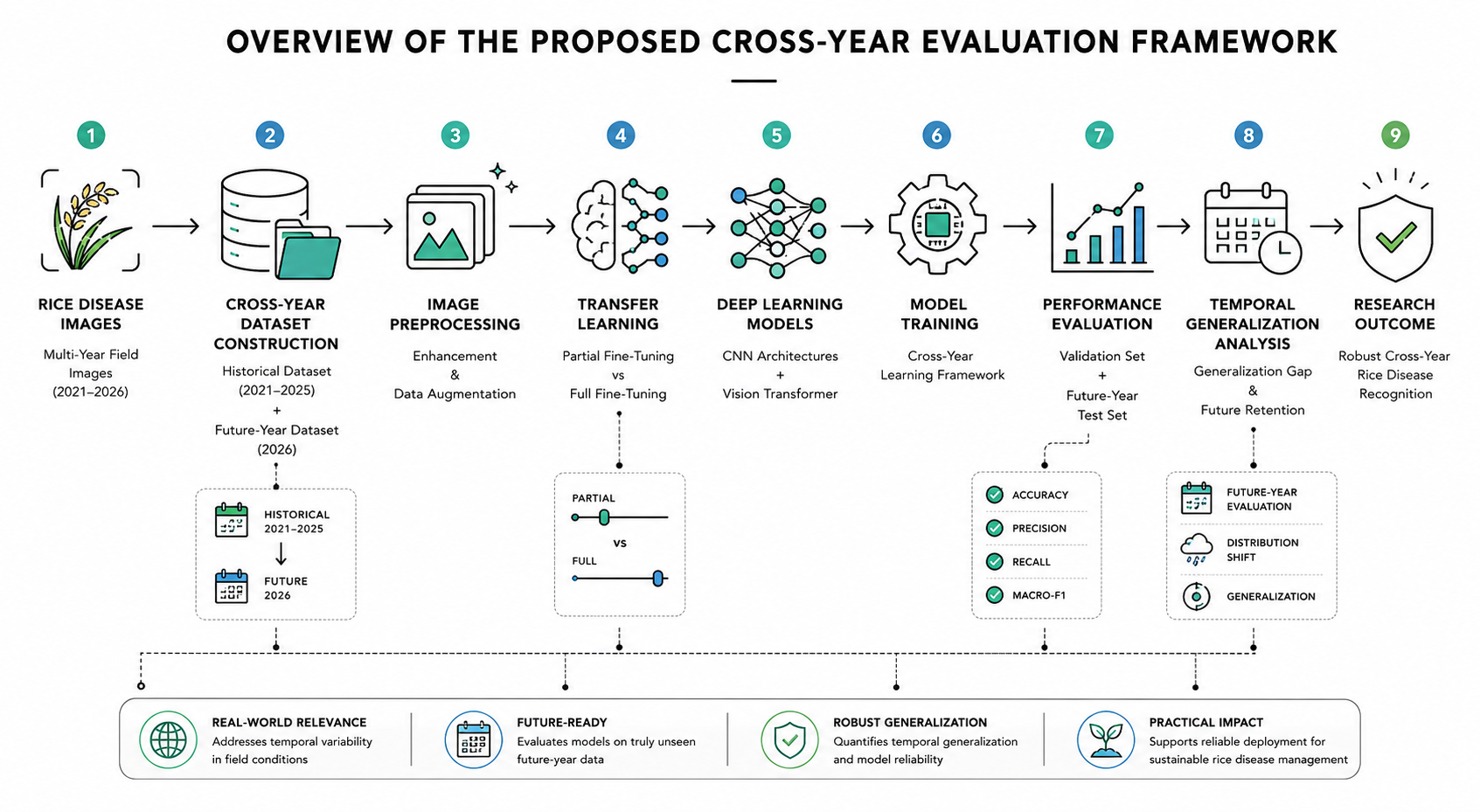
Does a rice-disease classifier that looks good this season still work next season? We check by holding out an entire year: four backbones (three CNNs and DINOv2), each with the backbone frozen or unfrozen, ten seeds each, trained on 2021–2025 and scored on 2026. Every setting loses more than half of its validation score on the new year, the loss is visible in the pixels themselves, and the fine-tuning choice that works best flips between the CNNs and the transformer. Numbers, tables, and code are in the paper and the repository below.
BibTeX
Status: accepted for presentation at the 3rd IEEE International Conference on Computing, Applications and Systems 2026 (9–10 October 2026); inclusion in IEEE Xplore follows presentation. The BibTeX below will be updated with page numbers and the DOI once the Xplore record is published.
@inproceedings{islam2026temporal,
  title     = {Leveraging Temporal Distribution Shifts for Rice Disease Detection},
  author    = {Islam, Md. Radoan and Chakraborty, Sayantan and
               Bhattacharjee, Ushashi and Roy, Tirtho},
  booktitle = {Proceedings of the 3rd IEEE International Conference on
               Computing, Applications and Systems},
  year      = {2026},
  publisher = {IEEE}
}